UK police are developing a national service for sharing local intelligence and police force data across the law enforcement and justice estate.
Announced by the National Police Chiefs’ Council (NPCC) earlier this year, the National Data Integration and Exploitation Service (NDIES) will allow local police forces to access and share data, including local force intelligence and digital forensics, from across the country.
Privacy campaigners have raised concerns that the project could facilitate artificial intelligence (AI)-powered analysis of bulk datasets of personal information which, when considered alongside facial recognition and other forms of real-time tracking, shows how “powerful” state surveillance apparatus is.
A “police data factory” within NDIES will incorporate data from over 50 law enforcement agencies, the Home Office, the Ministry of Justice, and “other” partners to provide them with access to a vast network of data for “analytical and reporting purposes”. These government departments will not be able to see operational data or intelligence itself, according to the NPCC.
Computer Weekly can also reveal exclusive details about key data exploitation systems used by several police forces expected to “plug into” NDIES datasets, including:
The National Data Integration and Exploitation Service
The National Data and Analytics Office (NDAO) within the NPCC is delivering the NDIES in collaboration with the Home Office. Kate Fisher-Stevens, director of the NDAO, has said the aim is “not to create a single national platform, collect more data or share it unnecessarily” but to “ensure data can be collated when necessary”.
“The creation of a centralised data infrastructure that supports cross-force, cross-system data sharing will be pivotal to that aim – creating a single version of the truth, with time, resource and subsequent cost significantly reduced,” she said.
In a pre-market engagement tender published last year, the capabilities for the NDIES were expected to cost between £75m and £250m over five years. Although no suppliers have been announced yet, documents obtained by Computer Weekly indicate that Palantir’s Foundry product is one of the preferred choices to meet these needs due to government and policing “interest”.
Design proposals for the delivery of police data integration and exploitation systems have also included plans to integrate criminal justice data with the Single Unique Identifiers being piloted by the Department for Education for child safeguarding.
Campaign groups have previously raised concerns with the Single Unique Identifiers as a child protection and crime reduction safeguarding initiative. The Traveller Movement, which advocates for Romany, Roma and Irish travellers, provided written evidence to Parliament warning that tracking children through these identifiers “could be perceived as an infringement on the privacy and autonomy of families who have historically faced marginalisation and excessive surveillance by public authorities”.
When asked if this has the potential to bring data on all school children into the hands of the police, the NPCC deferred the question to the Home Office, which in turn did not provide any answers.
The NDIES framework has been designed so that analytical tools can “plug into” national policing datasets to exploit the data. According to documents obtained by Computer Weekly under Freedom of Information laws, these tools appear to include an in-house system known as Prometheus and systems designed by Palantir and BAE Systems.
Exploitation of local policing intelligence and digital forensics, such as data extracted from mobile phones, will be central to the police’s plans, according to specifications seen by Computer Weekly.
A spokesperson and legal researcher from digital rights campaign group Privacy International said: “This is a step up in terms of how much data is being shared, and what forces across the board will be able to do with the data. It also opens up the possibility for using the data for predictive analytics.
“The amount of information that they can now collect and process, as they’re no longer having to dedicate human resources to this type of investigatory work, is alarming.”
Prometheus and Palantir Nectar: Data exploitation tools
Two key tools under development by the police are expected to play a key role in generating data and intelligence shared under the NDIES.
Computer Weekly has exclusive details about Prometheus, an “intelligence-only” system developed to aid analysis of digital devices seized from suspects.
Unlike tools such as Cellebrite, which decrypt and extract data from seized devices, Prometheus allows investigators to derive insights from the extracted data by cross-referencing it with other police systems. Personal data that police extract from mobile devices includes photos, text conversations and internet logs.
This allows investigators to build a picture of a case by identifying links and patterns between the data and existing police intelligence records. The outputs of intelligence-only systems are generally not admissible as evidence in court, however.
It is used primarily in child sexual abuse investigations so far, although there are plans to deploy it across a “far wider range” of offences.
Details of the system are considered so sensitive that the NPCC has not disclosed which five police forces are currently using it.
The NDAO’s Fisher-Stevens told Computer Weekly that a “number of forces have been involved in the development of Prometheus”, but she wouldn’t specify which, as this would “influence criminal tactics and significantly impact the interception of child sexual abuse”.
The NPCC refused to release details of the project’s collaborators, citing Freedom of Information Act (FOIA) exemptions that prevent the disclosure of information provided by or relating to the security bodies – for example, the National Crime Agency (NCA) or GCHQ.
The ultimate aim with Prometheus is national roll-out and availability to all police forces. It is currently live on the National Police Capability Environment, a web-based Microsoft Azure cloud platform.
Another tool currently being piloted by British police forces is Palantir Nectar. Bedfordshire Police contracted the US-based analytics firm Palantir Technologies to provide this service. It connects existing police data sources under a unified view, with underlying applications allowing investigators to exploit mobile phone data, profile individuals and process sensitive personal data with artificial intelligence.
It is built on the Palantir Foundry framework, the same system used in the NHS Federated Data Platform, which is an operating system that organises data and integrates it into specific analytics applications.
One application within Nectar called “Project Retrace” allows the police to map out locations an individual has visited based on troves of forensically extracted phone data, according to FOIA disclosures to Computer Weekly.
A Bedfordshire Police spokesperson refused to explain how this works. It’s unclear if the geolocation is based on cached data from apps that record your on-device location, by examining IP addresses that your phone has connected to, or through phone mast triangulation.
A spokesperson from digital rights group Privacy International said the police collect this data “through mobile phone extraction, cloud extraction, requesting information from mobile networks, and by purchasing data from data brokers”.
They added: “Many police forces hold this data not only from suspects, but from potential victims and witnesses of crimes.”
Several other applications within Palantir Nectar make use of forensically analysed device data. One has been specifically designed to support a national policing operation targeting Western Balkan organised crime and immigration offences. It appears that the AI has been trained to “recognise images of cocaine and cannabis” found in extracted devices, according to previous reports.
Another application within Nectar provides “AI-supported mobile phone analysis and translation” of extracted device data.
The system also analyses sensitive personal data, including people’s political opinions, religious beliefs and sexual orientations, according to previous reports.
Computer Weekly has obtained an equality impact assessment for Nectar, created before any contracts had been signed with Palantir. It does not mention people whose data could be trawled, only impacts on the workforce using the tool.
Concerns have been raised that “like any AI system, the outputs depend on the data fed into it” that “reflect historic and existing biases within these institutions and across wider society”, according to Alamara Khwaja Bettum, executive director of civil liberties charity Statewatch.
This will likely “lead to over-policing and criminalisation of marginalised communities, particularly racialised groups, migrants and people from low-income neighbourhoods”.
According to internal police documents obtained by Computer Weekly, the force has also not fully mitigated the risks of personal data being processed where the purposes are neither proportionate nor necessary. The volume of personal data processed may also be “excessive”.
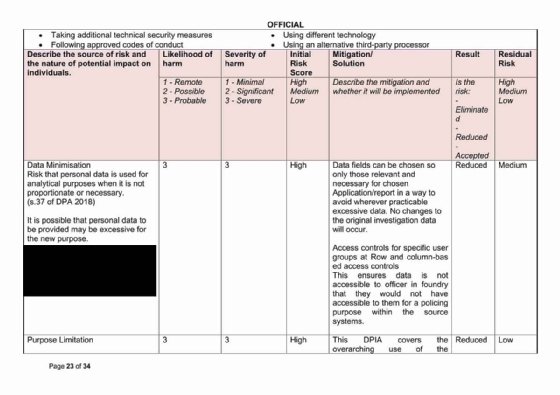
One of the data sources for Palantir Nectar – a system called Athena – contained more than 1,000 records for individuals in 2025 who had not been charged with any crimes, according to freedom of information disclosures to Computer Weekly. Any of this sensitive personal data could be analysed by Nectar’s AI processing if investigators were to choose to do so.
Privacy International said that this risks “disproportionate and unnecessary use of personal data, inaccuracy, data security, and the rights of freedoms of individuals”, which Bedfordshire Police has itself acknowledged in internal documents.
The campaign group continued that the police force’s decision to use Nectar to “expand its surveillance capabilities by exploiting deeply intrusive data about individuals, without concern for [Palantir’s] human rights record, and without fully explaining how the data will be used or how many people this project will affect, raises serious legal and ethical concerns”.
Bedfordshire Police is leading the Palantir Nectar pilot within the Eastern Regional Special Operations Unit (ERSOU), a joint policing unit tackling serious organised crime and terrorism. Cambridgeshire and Hertfordshire constabularies have access to the platform through Bedfordshire Police. These forces, alongside Essex, Kent, Norfolk and Suffolk constabularies, make up the rest of the ERSOU. The pilot is in preparation for a national roll-out of the software.
The pilot is being partially audited by Accenture. This same consultancy firm has recently announced a “global strategic partnership” with Palantir, acquired a company that helps organisations implement Palantir’s software, and is part of the same consortium earning from the multimillion-pound NHS contract.
Representatives for Accenture acknowledged Computer Weekly’s queries but failed to respond.
Bedfordshire Police did not answer questions about whether it considered a conflict of interest in having Accenture audit its pilot, given that the firm could stand to gain from Palantir obtaining further government contracts, but a spokesperson said the force is also evaluating the project internally.
Bedfordshire Police said it is “imperative” that police systems evolve to “provide a service the public expects” given the changing policing landscape. The number of domestic violence disclosures has also trebled as a result of the Palantir Nectar pilot, according to the force. An ethics panel composed of police officials and academics is providing “independent scrutiny” of AI use, while the police and crime commissioner is also establishing an Artificial Intelligence Advisory Ethics Panel.
A Palantir spokesperson said the firm is “proud” the software is fighting crime. “But that is what it is – software. How that software is used to process data is entirely under the control of the customer. Critically, use of the software does not involve acquiring any data that the customer in question doesn’t already have access to – it simply organises that data in a way that enables faster, better decision-making.”
Palantir also confirmed to Computer Weekly that its software has been used by the US military for airstrike targeting in Iran.
“Palantir has developed its technologies by testing them in war-torn countries and using them in the genocide in Palestine,” according to Romain Lanneau, a legal consultant at Statewatch. “Based on that alone, the UK should consider any collaboration with Palantir highly unethical.”
Leicestershire Police is also leading a Palantir Nectar trial within the East Midlands Special Operations Unit (EMSOU), which includes Derbyshire, Lincolnshire, Northamptonshire and Nottinghamshire Police.
London mayor Sadiq Khan recently blocked the Metropolitan Police’s £50m deal with Palantir as the proposal had not “ensured or demonstrated value for money”, although the force has been able to continue using it for the next year.
Police plans to integrate IT systems
Police chiefs had previously expressed concerns about reliance on the multiplicity of commercial and in-house platforms such as Palantir Nectar, Prometheus and BAE Systems’ Intelligence Lead Assessment Service, and existing systems such as the Police National Database, which risk “excessive costs” and “architectural incoherence” given that they would all be using the same data, according to documents obtained by Computer Weekly.
The solution, therefore, was to bring all of the police’s data exploitation and collation tools under one roof.
“The National Data and Analytics Office is working to centralise the way in which forces utilise data and procure data exploitation technology – to reduce duplicated investment and again, protect forces against the risks [mentioned],” the NDAO’s Fisher-Stevens told Computer Weekly.
Following on from London City Hall blocking the Met’s £50m contract with Palantir, commissioner Mark Rowley warned against the constraints of public procurement policy on the police’s ability to deploy emerging technology effectively. Rowley said the force stands to gain from being able to “connect” and “spot patterns at the touch of a button” across the force’s 2,200 datasets held in over 600 systems.
The NDIES appears to answer this concern, giving the police access to a wide range of national intelligence in an organised way. Yet the underlying risks raised by campaign groups on biases within the data and the invasive nature of collection remain. “The question is whether it can possibly be necessary and proportionate,” according to Privacy International.