TL;DR
- Agent Upgrade: OpenAI’s GPT-6.1 Terra model improves coding and computer work at lower prices for developers integrating it into software.
- Workload Gaps: In separate tests, Terra missed hidden data patterns and struggled with repeatable accounting tasks.
- Agent Access: Terra is available in ChatGPT Work for multistep tasks and Codex for coding, outside ordinary ChatGPT conversations.
OpenAI released GPT-6.1 Terra on October 26, 2026, as a lower-cost model for AI agents that carry out multistep computer tasks. For developers choosing a model to write code or handle office work, the update offers substantially stronger measured coding performance than the previous Terra tier.
The model’s supported work includes matching product photos to catalogue entries, interpreting technical drawings, operating application screens and drafting text. It succeeds GPT-5.6 Terra, the balanced tier introduced alongside Sol and Luna in July.
Terra can vary its reasoning effort, the amount of reasoning it does before answering. On Agents’ Last Exam, OpenAI reports a 15-percentage-point improvement over GPT-5.6 Terra at medium reasoning effort, at about one-third the measured task cost. The exam covers professional tasks such as turning architectural drawings into a 3D model. OpenAI also reports completing its tasks more than three times faster than GPT-6 Astra and GPT-6.1 Sol.
Coding Gains Depend on the Reasoning Setting
Independent evaluator Artificial Analysis measured an approximately 20-percentage-point gain over GPT-5.6 Terra on Terminal-Bench 4.0, which tests agents working through command-line tasks. At maximum reasoning effort, Terra rivalled GPT-6.1 Sol on that test. Sol retained a six-point lead on the lab’s broader Coding Agent Index, which combines coding evaluations.
The improvement also showed up in the lab’s general Intelligence Index. At maximum effort, Terra gained six points over its predecessor while the weighted average cost per evaluated task fell from $1.40 to $0.40. That cost includes tokens used for input, cache reads and writes, reasoning and answers. Tokens are the units used to meter model input and generated output.
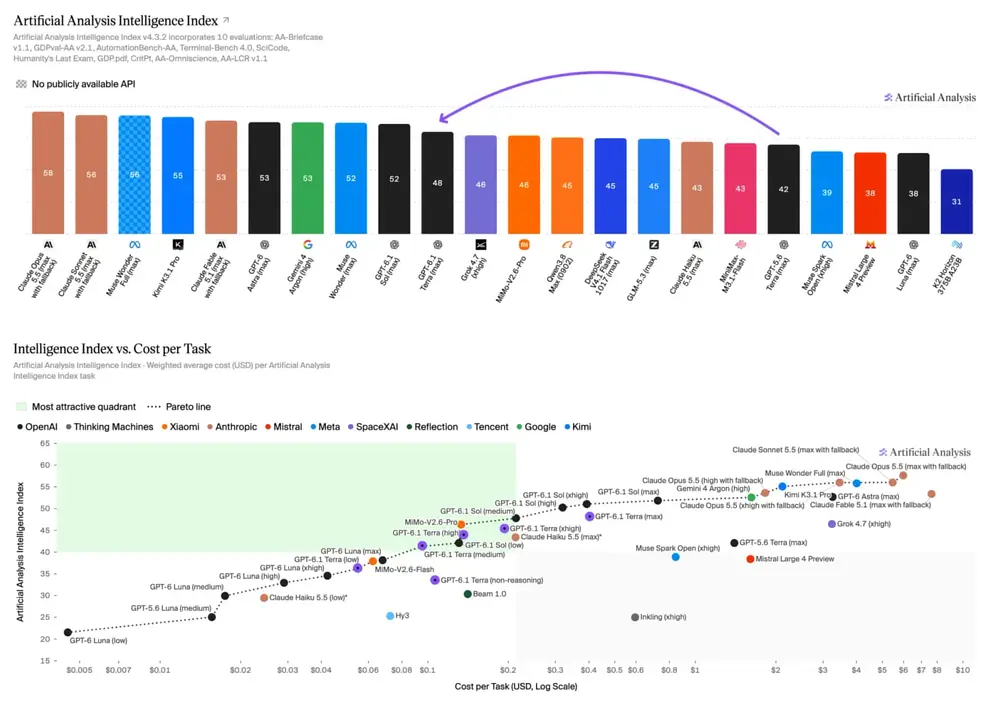
Terra’s API, the software interface developers use to call the model, defaults to medium reasoning effort. Artificial Analysis found that low and medium effort reached its general intelligence cost-efficiency frontier, meaning no tested alternative was both more capable and cheaper at those points. For coding, the corresponding settings were low and xhigh, the extra-high setting below maximum effort. Maximum effort delivered more capability, but other configurations offered a better capability-cost trade-off.
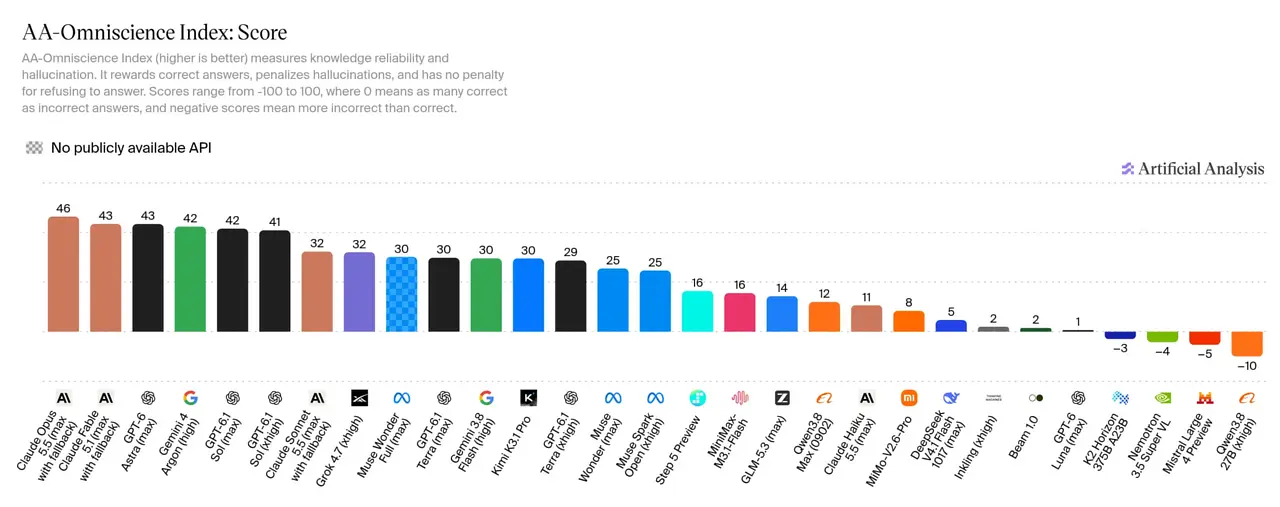
Artificial Analysis described smaller improvements across most of its other evaluations. On AA-Omniscience, its knowledge test, Terra guessed on 38% of questions whose answers it did not know, down from 88% for the previous Terra. Accuracy on the same test rose by two points.
A Fast Analytics Agent Still Misses Patterns
Analytics software maker Plotly tested Terra in its own data agent, using read-only tools to query a synthetic wind-fleet database, draw charts and present tables. Its 43-question exam included ordinary analysis, ambiguous or impossible requests, statistical traps and planted data problems.
One request asked for turbine output figures to quote in a monthly operations report. Terra noticed that the final day was missing and that some rows were duplicated. It left turbines without readings blank and limited the figures it supplied to the dates the data actually covered.
Plotly compared Terra with the cheaper GPT-6 Luna and higher-scoring GPT-6.1 Sol. All three handled the straightforward analytics questions. The differences appeared in harder statistical questions and hidden patterns: Terra found three of five planted patterns, while Sol found all five. Terra missed an alarm-log anomaly and stopped at comparing component types when asked which components were failing unusually often.
Plotly’s 43-question analytics exam
Plotly attributed Terra’s short completion times to brief answers and relatively few model calls. It generated about 1,460 output tokens and made about 4.5 calls per question; its roughly 64 tokens per second was ordinary in that test. Most input was reused from cache, which also helped keep the full-exam bill down.
The test’s method uses private, fabricated data and an AI judge. Plotly says a gap of one or two questions is within the noise.
Accounting Rewards Repeatable Answers
Accounting software maker DualEntry found a less favourable trade-off in its 101-case accounting test. Terra averaged 16.1 seconds per task at $0.042 per attempt, but its reported accuracy was 78.2%. A case counted as passed when it succeeded in at least two of three runs; only 65.3% passed in all three.
The tool-based cases require models to look up accounts, vendors and customers and create draft records. Fixed checks compare the results with reference accounts, debit and credit entries, and amounts. Terra handled transaction classification and journal entries well, but passed only 7 of 13 payables cases and 7 of 12 cases each in receivables and month-end close. Those are recurring operations for which a fast answer can still require review and correction.
In the same benchmark, DeepSeek V4.1 Flash scored 84.2% at $0.003 per task, giving it both a higher pass rate and a lower measured bill than Terra.
DualEntry uses synthetic scenarios and a restored test company, with deterministic grading rather than an AI judge. The Terra-specific report leaves its exact run configuration and date unspecified.
How Reuse Changes API Costs
Terra’s Standard API rates are $1 per million input tokens, $5 per million output tokens and $0.05 per million cached input tokens. Those rates are half GPT-6.1 Sol’s; the previous Terra rates in Artificial Analysis’s comparison were $2 for input and $12 for output.
OpenAI also added an optional 12-hour prompt-cache lifetime during October. Caching saves processed input for reuse when later requests begin with the same material. A stable rubric and examples, for instance, can be reused while each new interaction being graded follows them. Selecting just that stable beginning avoids paying to cache changing material that will not be reused.
The longer lifetime trades a higher initial charge for reuse across wider gaps. Terra costs $1.25 per million tokens written for the default 30-minute minimum, or $2.50 for a 12-hour minimum; subsequent reads cost $0.05 under either choice. Cache-write and cache-read rates replace the ordinary input rate for those tokens.
Above 272,000 input tokens, input and cache rates double and output rises to 1.5 times Standard for the whole request.
Work and Codex Are the Product Entry Points
Terra is available in ChatGPT Work and Codex. ChatGPT Work handles longer, multistep tasks and finished deliverables; Codex focuses on software development. Model choices depend on plan and workspace settings. Signing into Codex with ChatGPT uses the plan’s usage and billing; using an API key, a developer access credential, follows API pricing.
OpenAI classifies Terra as Critical in cybersecurity capability and High in biological and chemical capability. It applies the same safeguards used for GPT-6.1 Sol and GPT-6 Astra. These are OpenAI’s capability-risk categories for deciding which protections to apply.